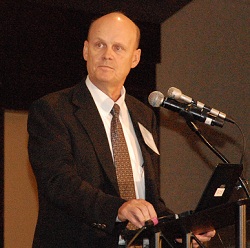
A hot topic at this year’s World Pork Expo was the pending free trade agreements that are awaiting Congressional approval. Don Butler, immediate past president of the National Pork Producers cited the agreements between the U.S. and Colombia, Panama and South Korea could make a world of difference for the pork industry in this country. In fact, Butler says the agreement with Korea, if approved, could add at least $10 a head to hog prices (compared to about a dollar or so the Colombian and Panamanian agreements would add). Download (mp3) Butler’s remarks about the agreements at World Pork expo – or listen in the player: wpx10-butlertrade.mp3
Later, during a stop at the media room, I was able to sit down with Jong Hyun Choi, the Minister to the U.S. for Economic Affairs in the South Korean Embassy in Washington, D.C. and get his thoughts on the pending agreement. He pointed out that the agreement were signed three years ago, but Congress has not given final approval to implement the provisions.
“It’s just about past time for the agreement to be ratified, approved by the U.S. Congress.”
He went on to say one of the main reasons for his visit is to promote the FTA and point out the huge benefits U.S. pork producers and South Korea could see once it is approved.
“Once this agreement is implemented, then the more than 20 percent tariffs (currently on U.S. pork) will be eliminated for frozen pork and within 10 years for fresh and chilled products. So, that implementation could provide a very commercially meaningful leg up for U.S. pork producers.”
Choi added that South Korea has just completed a free trade agreement with the European Union, while hog farmers in Chile have already been enjoying much lower tariffs for the past six years, increasing their market share in South Korea. That trend worries the NPPC, as Butler believes lack of ratification of the U.S.-Korea and other FTAs could end up shutting out American hog farmers from those markets in the next 10 years.
Choi agreed that Congress needs to get moving on this issue, and pork producing groups, such as the NPPC, will need to help push that.
You can hear more of my conversation with Minister Choi in the player below.
Check out all the World Pork Expo 2010 Photo Album
AgWired coverage of the World Pork Expo 2010 is sponsored by:
and
.


First, they held a PRRS Area Regional Control workshop on Wednesday and Thursday that was for producers and veterinarians to find out what they can do to implement ARC. On Friday morning, they presented the “science behind the success” of the program for the media.
Dr. Jean Paul (JP) Cano recently joined BIVI as a professional services veterinarian after years in private practice and he says he is optimistic about the potential for controlling PRRS. “What it takes is collaboration and coordination between farms in the same area and sharing the risk of becoming infected,” he said. In addition to the biosecurity measures, JP says PRRS vaccination also plays a critical role in the control and eradication of the disease. “We think that vaccine is one more tool in the tool box that we have to fight this disease in the area regional control concept.”
Sustainability was the focus of the 2010
I talked to Paul Rea, VP of BASF U.S. Crop Operations, about the survey and the video and decided it would make a good ZimmCast this week because it reflects what agriculture is up against and how companies like BASF are helping farmers face the future.
The folks at 


“Holistic” and “durable” were two definitions for sustainable that were set forth by representatives of the food value chain, from farmers to food companies, who took part in a panel discussion at the 
Some time during the rain, general manager John Wrigley stopped by to visit with the folks at the Novus International tent and chatted with us for a while about how pleased he was with the attendance and to have international visitors back this year.