
 Participants on this week’s he 2011 CTIC Conservation In Action Tour in Ohio heard a clear case for cover crops from farmer Allen Dean in Williams County.
“For several years now we’ve been watching our watersheds when we get these large rainfall events and it’s been interesting to see where we have some type of cover crop, water coming off those watersheds is virtually clean – you could actually drink the water, it’s so clean,” Allen said. He demonstrated the difference to the tour group with jars of water collected off fields after recent rains. He’s holding the jar with water from his fields.
Dean Farms grows wheat and non-GMO soybeans on 1900 acres where they plant a variety of cover crops, including annual rye, cereal rye, clover and radishes. “We’ve been using radishes for 4-5 years now,” he said. “They’re called a daikon radish and the advantage of radishes is they’ll actually open up the soil, they’ll drill down deep into the soil, they have a long tap root and a lot of ladder roots.” When winter comes, the radishes die and start decomposing and come spring “the soil is clean as far as any type of residue.”
Interesting interview with Allen Dean here: Farmer Allen Dean
CTIC 2011 Conservation in Action Tour Photos
AgWired coverage of the CTIC Indian Creek Watershed Field Tour is sponsored by AGROTAIN
 One stop on the
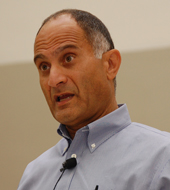
  Al Bensch, vice president of northern operations for The Andersons Plant Nutrient Group, spoke on one of the three tour buses as we drove past much of the company’s Maumee, Ohio operations. “We have 27 locations in the fertilizer business – Ohio, Michigan, Indiana, Illinois, Wisconsin, Minnesota and Florida,” Al said. “We handled last year a little over two million tons of fertilizer.”
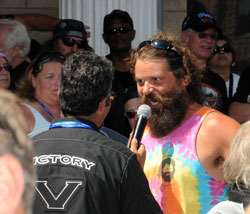
 We made a very brief stop at the Anderson family compound where we heard from the Plant Nutrient Group president Denny Addis about the Andersons’ commitment to agriculture and the environment. “Production agriculture and care for the environment are not mutually exclusive, they need to work in harmony together,” he told me in an interview. “We’ve got to continue to find more ways to produce more fiber, more food, more energy for the world at the same time make sure we care for the environment.”



 The rosy glow over the Maumee River as we returned from the