
Irish Guild of Agricultural Journalists Commemorates 50 Years

Chuck Zimmerman

The Irish Guild of Agricultural Journalists has just released a 50th Anniversary document (pdf) that includes historical information and photos. Here are a couple of samples:

In 1961 we had a visit from John Hayhurst, President of the Guild of Agricultural Journalists, London. He was editor of a weekly called The Smallholder. He was exploring Ireland’s potential for membership. He was met by Henry Kennedy, director of IAOS (now ICOS) and General John Costello, chief executive of the Irish Sugar Company.

New scope had arisen with the imminent launch of RTE television and the growing significance of public relations for the larger agricultural bodies like the Department of Agriculture, the Irish Sugar Company and the newly formed Bord Bainne.

and

The Guild’s Journalism awards honour professionals who have achieved excellence in journalism and communications. The awards were initiated in 1976 in honour of the late Vincent Colgan, public relations manager with Bord Bainne (now the Irish Dairy Board).

The Journalist of the Year was selected by nomination and ballot of Guild members and was presented with the bronze bull. There was just one annual award which was presented at the Bord Bainne sponsored function for the Guild, held on the eve of the RDS Spring Show.

IFAJ, International, Media

Zimfo Bytes

Melissa Sandfort

    Zimfo Bytes

  • The 2012 Great Plains Growers Conference is set for Jan. 5-7 at the Fulkerson Center on the campus of Missouri Western State University in St. Joseph, Mo.
  • Everyone is welcome to attend the International Agri-Center’s annual Brunch with Santa in Tulare on Sunday, December 11, from 11 a.m. to 2 p.m.
  • Wilbur-Ellis has developed a recruitment and leadership program called Next Generation designed to attract and train new talent for the future of agriculture.
  • Cooperative Network bestowed its Cooperative Builder Award, the organization’s highest honor, on three cooperators: Dennis Hunwardsen, Ron Tenner and Lee Uldbjerg.
Zimfo Bytes

Small PRRS Projects Seeing Success

Chuck Zimmerman

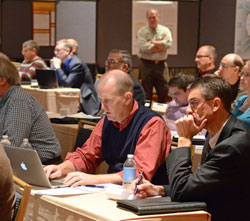
Dr. Jim Lowe is an independent veterinarian and one of the attendees at the Boehringer Ingelheim PRRS ARC&E Seminar. He’s the guy on the Mac. I asked him why he attends this seminar.

Jim says that he spends a lot of time dealing with PRRS and this program allows him time to visit with colleagues and share information. He’s involved with several regional control projects and says this ability to share information is very valuable. He says these projects are “a tough row to hoe.” One of the things he’s been seeing is that the small well-defined projects with good producer participation are having some success. There’s that need for participation coming up again in one of my interviews. Jim says that sometimes it’s not so much a science project as much as a “persuasion” project to get producers to participate.

You can listen to my interview with Jim here: Jim Lowe Interview

2011 Boehringer Ingelheim PRRS ARC&E Seminar Photo Album

Agribusiness, Animal Health, Audio, Boehringer Ingelheim, Swine

BASF Updates Ag Aviators on New Labels

Cindy Zimmerman

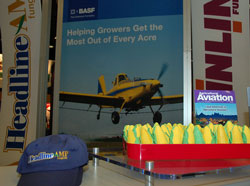
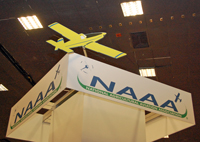
naaaDuring the National Agricultural Aviation Association NAAA convention this week, Dr. Gary Fellows had the opportunity to educate aerial applicators on what’s new from BASF.

Gary participated in a session with a few other crop protection product companies to provide an update on BASF herbicides and fungicides. First of all, Gary talked about the anticipated registration next year of Priaxor for soybeans. “It gives a brand new mix of fungicides for both controlling existing diseases and providing preventative disease control,” Gary says. “It raises the bar with what Headline is today as the standard in the soybean market, with more consistency, better yield and a higher return on investment for the grower.”

naaaGary says a new liquid formulation of Facet® herbicide has benefits for rice producers. “We’ve been selling Facet as a dry formulation for years,” he explained. “We’re excited to sell a true liquid because of the ease of handling and we also get better grass and broadleaf activity with it.”
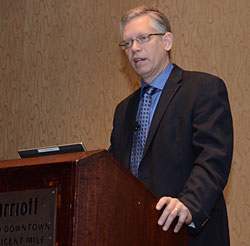
In addition, Gary updated the ag aviators on two new label expansions from BASF, for Prowl® herbicide on pasture grasses and for Headline® fungicide in alfalfa.

When I interviewed Gary, he also talked about the importance of ag aviators to agriculture and the overall goal of feeding a growing population. Listen to or download my interview with Gary from NAAA here: Dr. Gary Fellows with BASF

2011 NAAA Convention Photo Album

AgWired coverage of the 2011 NAAA Convention is sponsored by BASF.
Audio, BASF, NAAA

Wellman Elected President of American Soybean Association

Chuck Zimmerman

The American Soybean Association announced today that Steve Wellman from Syracuse, Nebraska, is President and Alan Kemper from Lafayette, Indiana, is confirmed as Chairman. Also elected was Danny Murphy from Canton, Mississippi, to serve as First Vice President, an office that places Murphy in line to be ASA President in 2013.

Also elected were Randy Mann from Auburn, Kentucky, as Secretary, and Bob Henry from Robinson, Kansas, as Treasurer. Four Vice Presidents were also elected: Ray Gaesser from Corning, Iowa; Bob Worth from Lake Benton, Minnesota; Richard Wilkins from Greenwood, Delaware; and Wade Cowan from Brownfield, Texas. These soybean farmer-leaders form the nine-member ASA Executive Committee. Elections were held on Wednesday, Dec. 7, during ASA’s winter Board of Director’s meeting in Saint Louis.

“My goals include increasing demand for soybeans and soybean products, addressing regulatory issues to keep farmers competitive globally, seeking fair farm bill provisions for growers, promoting more ag trade and continuing ASA’s leadership development programs,” Wellman said. “Global demand for soy has increased 145 percent since 1990 and it is anticipated demand will continue to increase. Policy including a sound crop insurance program complemented by a revenue program that does not distort planting decisions is needed to help ensure the U.S. soybean farmer can manage production and price risk while producing soybeans to meet the needs of our consumers domestically and internationally.”

Ag Groups, ASA, Soybean

First Snow

Melissa Sandfort

I was at a loss for what to write about today and then Mother Nature stepped in and delivered the first snow of the season. Western Nebraska had between 6 to 8 inches on Saturday but we only had rain (and I’m not complaining). Today is a different story. We’re only supposed to get an inch, but it’s much-needed moisture for the fields. Farmers had been busy to the bone applying anhydrous the past month but activity in the fields came to a hault more than a week ago.

University of Nebraska-Lincoln extension specialists say that 12 inches of snow could provide farmers 0.8 to one inch of additional soil moisture in the soil profile. That moisture could make a difference of 8 to 12 additional bushels per acre of corn yield. That moisture is especially valuable to dryland crops and the irrigation farmer benefits from reduced irrigation pumping costs, too. Al Dutcher, state climatologist, says precipitation during the winter recharge period of Oct. 1 to April 30 is critical to Nebraska crop production.

I’ll put on my snow boots and drive on muddy roads if it’s helping the farmers. Let it snow!

Until we walk again …

Uncategorized

Financial Impact Of Eliminating PRRS

Chuck Zimmerman

There is a serious financial impact from the PRRS disease in pigs and at the Boehringer Ingelheim PRRS Seminar we learned how much. Dr. Derold Holtkamp, Iowa State University, made a presentation titled, “Bio-economics: The Impact of PRRS & PRRS Control. He had recently completed a Pork Board cost of PRRS study and says they were able to use that data to calculate the impact of the disease in an area control project.

He says they looked at a Minnesota project which they felt best exemplified success at elimination of the disease and asked the question, “What was the value of the productivity improvements in that county after they successfully eliminated the virus there?” So they made a comparison between having the virus eliminated and projecting out to 2018, to if the area had continued in that time period without having the virus eliminated. The difference was positive $4.2 million to the county, using a net present value analysis, if they completed the project. That sounds like real value for going to the effort of getting rid of this disease!

You can listen to my interview with Derold here: Dr. Derold Holtkamp Interview

2011 Boehringer Ingelheim PRRS ARC&E Seminar Photo Album

Agribusiness, Animal Health, Audio, Boehringer Ingelheim, Swine

South-East Iowa PRRS Project Update

Chuck Zimmerman

Providing a report on the progress of the South-East Iowa PRRS ARC&E Project during the BIVI PRRS Seminar was Dr. Tim Loula, Swine Vet Center. He says these projects to try to eliminate Porcine Reproductive and Respiratory Syndrome are similar to ones conducted some time ago for Pseudorabies. He says the Iowa program was started in a very pig dense area to get ready to “clean up” this virus. The project was started in 2010 and the goal was to have everyone do the same thing. He says it’s going to be a long journey.

Tim says they have about eighty percent buy in from producers in the area which has taken a lot of legwork. They’ve started mapping and have some early indication that the efforts have reduced some finishing mortality. This is going to be a multi-year project since PRRS is a very difficult virus and travels very fast in pig dense areas. If successful the area would be expanded and copied in other similar areas.

You can listen to my interview with Tim here: Dr. Tim Loula Interview

2011 Boehringer Ingelheim PRRS ARC&E Seminar Photo Album

Agribusiness, Animal Health, Audio, Boehringer Ingelheim

Ag Aviators Facing Unnecessary Regulations

Cindy Zimmerman

naaaLike all of agriculture, aerial applicators are facing potentially onerous regulations that could ground them if they are allowed to continue.

The biggest issue they are dealing with right now is the National Pollutant Discharge Elimination System (NPDES) permit program, which National Agricultural Aviation Association executive director Andrew Moore told me just went into effect on Halloween. “It’s kind of a scary regulation,” said Andrew of the regulation which impacts pesticide application near water. “The problem is that it’s duplicative of everything that already exists to protect the environment in regard to pesticide regulation.”

naaaAndrew says the NPDES would require a great deal of paper work on the part of applicators. “FIFRA already regulates the safety of pesticides to water, so this is a completely unnecessary burdensome rule.” In addition, Andrew says they are very considered about lawsuits under the new regulation.

So, NPDES was a big topic at the NAAA convention in Las Vegas this week, where workshops were held and applicators were educated about the current status of the federal rule and where it stands at the state level. Andrew says they are also urging aerial applicators – and really anyone in the agriculture industry – to contact their senators about the issue. “Because we’ve been successful in passing legislation that would exempt pesticide applications over water for FIFRA approved pesticides,” said Andrew. The measure has been passed by the House and has gone through the Senate Agriculture Committee. “We believe we have the votes in the Senate but it’s not being brought to the floor for a vote,” he said.

Listen to my interview with Andrew here: NAAA executive director Andrew Moore

2011 NAAA Convention Photo Album

AgWired coverage of the 2011 NAAA Convention is sponsored by BASF.
Audio, BASF, Environment, NAAA

Sharing PRRS and PRRS Control Information

Chuck Zimmerman

This is my favorite Dr. Laura. She’s Dr. Laura Batista, Boehringer Ingelheim Vetmedica and she was our moderator at the PRRS ARC&E Seminar in Chicago last week. I had to wait until today to get these posts done (more coming) since I had to re-voice my part of my interviews due to losing my voice end of last week. It’s almost back to normal.

So Dr. Batista says the goal of the seminar was to share all the new information about PRRS and PRRS control projects. By bringing a diverse group of scientists and veterinarians together BIVI hopes this will improve the spread of information and collaboration and perhaps avoid duplication of efforts which would save on resources. The seminar was divided into three sections. First was a report on a couple of area control projects. Then the presentations focused on the different tools that are available like mapping and monitoring and surveillance. Then the seminar ended in an open forum for questions and answers and additional sharing of information.

You can listen to my interview with Laura here: Dr. Laura Batista Interview

2011 Boehringer Ingelheim PRRS ARC&E Seminar Photo Album

Agribusiness, Animal Health, Audio, Boehringer Ingelheim