
 Last week was county fair week and that means one of our local towns was filled with carnival sights, funnel cake smells and 4-H animal sounds. Our son loved every minute of it and the entire time I kept thinking how much better this all was when I was a kid – funny how growing up ruins everything.
Getting to see all of the animals was the highlight of the weekend. And much to my surprise, I never was asked, “Mommy, can we have chickens? Can we have a rabbit?” He seems to be content with black kitty and our horses.
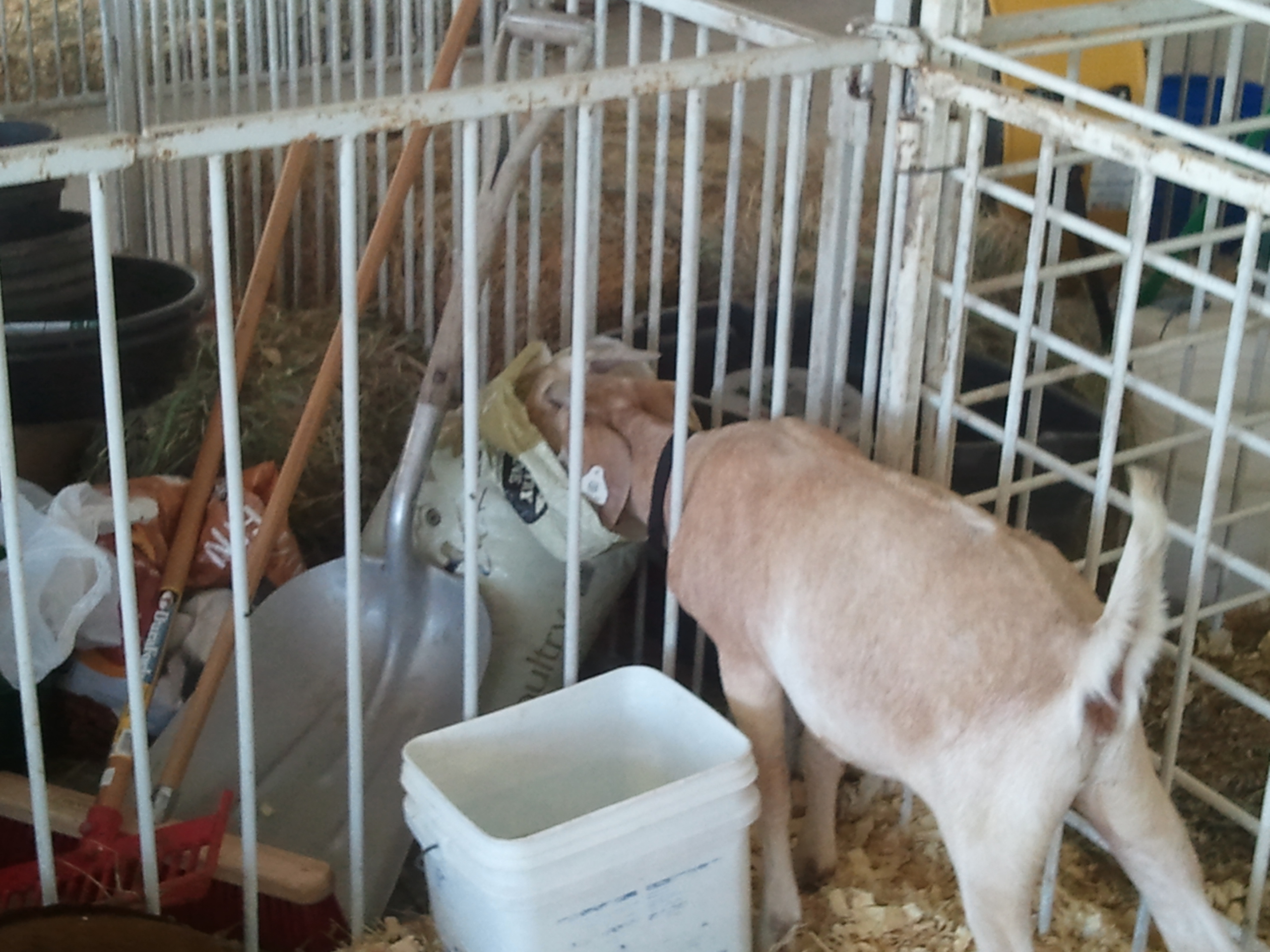
We were touring the goats (which were my son’s favorite) when I caught sight of the smartest one in the show arena. Can you see him sticking his head through the fence chowing down on the bag of feed? I had to laugh and think to myself – “Follow your nose little guy! That’s right – it’s 100 degrees and if you can get a little extra nourishment, the judges will never know.”
As our son grows and is able to “do” more at local events, I get a clearer picture of where our summer days are headed…showing our horse Thelma in 4-H. I’m just not sure I’m ready for a goat yet.
Until we walk again …






 Hello young agrimarkeing professionals. Want to get a leg up on your career and network with some of the best and brightest? Check out
 NCBA testified at an EPA hearing in Philadelphia Tuesday in opposition to any attempt to lower the coarse particulate matter (PM) standard as part of the National Ambient Air Quality Standards (NAAQS). Every five years, the EPA is required to review scientific studies associated with “criteria pollutants” regulated under the NAAQS of the Clean Air Act to determine if the pollutant is regulated appropriately. One of the criteria pollutants is PM, which includes dust. PM in arid western regions is made up primarily of mechanically generated crustal material, including fugitive dust. The coarse PM emitted from cattle operations is fugitive particulate matter or fugitive dust, which is the result of windblown dust and cattle movements. Because rural coarse PM is largely a natural phenomenon, it is extremely difficult to ensure compliance with the standard in dry, arid regions where coarse PM predominates despite use of best management practices.
