CF Industries Holdings, Inc. announced that Adam Hall has joined the company as vice president, corporate development.
The National Council of Chain Restaurants launched “Feed Food Fairness: Take RFS Off the Menu,” a new grassroots campaign focused on repealing the federal Renewable Fuel Standard and the corn ethanol mandate.
The Progressive Farmer announces the expansion of its agronomic and crop focus within a new branded magazine edition called SouthernLink.
Two new employees joined the team Swine Division in April. Gregory Lewis is regional sales manager and Nathan Schaefer, DVM, is a professional services veterinarian. Both joined the company in April. Lewis was area sales manager for Land O’ Lakes for the past two years and previously spent 19 years in various sales management and marketing positions with Alpharma. Dr. Schaefer spent two and a half years as a swine production veterinarian for Iowa Select Farms in Iowa Falls, Iowa, where he oversaw the health management of the company’s farrow-to-wean and gilt development programs.
Jean Paul (JP) Cano, DVM, has been promoted to senior associate director of Swine Professional Services. Cano earned his DVM in Venezuela and his Ph.D. from the University of Minnesota. He gained broad experience as a swine practitioner in Venezuela, where he also wrote a number of peer-reviewed journal articles. Cano joined the BIVI Swine Division in 2009. We’ve interviewed JP a couple of times here on AgWired – once at World Pork Expo in 2010 and again at the 2012 PRRS Symposium.
Erin Johnson, DVM, has been promoted to technical manager on the PRRSolutions Team, which leads the Area Regional Control & Elimination (ARC&E) efforts and is supported and advised by recognized PRRS experts from across the U.S. The team conducts and coordinates the research, design and development of the ARC&E and plays an active role in supporting efforts of ARC&E working groups across the country.
“We’ve been four out of the last five years to the event,” Eric told me. “One of the hot words that we hear with employers is ‘supply chain’ in agriculture and food industries and this talent pool represents that.”
Eric says the students who take part in the IFAMA world forum and competition are the people who are gaining the skills it will take for the future of agribusiness. “Many of them are Masters or higher levels students who understand ag economics who want to work in the global food chain,” he said, noting they are also very mobile and multi-lingual. AgCareers sponsored a Career Expo and Career Services Center at the IFAMA World Forum in Atlanta last week.
The whole goal of AgCareers.com is to bring this type of talent and agribusiness employers together, and also to make sure that these students have the skills needed for the future of the industry, which is what the upcoming AgCareers 11th Ag & Food HR Roundtable is all about. “We’re going on the campus of DuPont Pioneer in Johnston (Iowa) the first week of August and we have 150 registered attendees and we only have 50 more slots,” Eric said. “And that’s a good thing.”
Attending the HR Roundtable will be agribusiness human resource professionals, executives and managers, university and college faculty & career services staff, and association representatives. For registration and further information, click here and follow the links.
Monsanto officials held a press call on Friday regarding “suspicious” evidence in the investigation of genetically engineered wheat plants found in an Oregon field last month that suggests it was possibly intentionally planted.
“The evidence now collected, the fact patterns established and the original Roundup Ready CP-4 event appearing suddenly after 12 years, out of nowhere in a single field in the state of Oregon is highly suspicious,” said Monsanto Vice President and Director of Technology Robb Fraley, stressing that they don’t know the grower or the field or have the plant samples available. However, “the more data we generate, the more clarity we’re getting on this, and the more suspicious it looks.”
When pressed by reporters, Fraley said, “It’s fair to say that there are folks who don’t like biotechnology and would use this as an opportunity to create problems.” He also pointed to the recent destruction of two sugar beet fields in the state of Oregon by anti-GMO activists.
Jimmy Maxy, Secretary/Treasurer for the Cattlemen’s Beef Board and cattleman from California, took in the event and spoke with Chuck on the importance of the two organizations working together.
“The funding that comes from the promotion of beef, comes from cattlemen and cattlemen market their cattle through livestock markets. Each time that happens it’s a source for beef promotion. It’s our job to take those funds and do the best we can with them and bring back great returns to cattlemen.”
He also added that it was a great chance to personally interact with producers, that livestock markets are a collection point for checkoff funds and it serves as a way to educate producers about the checkoff program.
With the Senate poised to vote on comprehensive immigration reform this week, USDA held a forum on the issue Friday in Kansas City, featuring Agriculture Secretary Tom Vilsack, former Kansas City mayor and current Congressman Emanuel Cleaver, and representatives of the nation’s dairy industry.
“We are blessed by the most productive, most innovative and most hard-working farmers and ranchers,” Vilsack said. “American agriculture is the greatest in the world, but we risk that if we don’t have certainty in our farm policy and we don’t have comprehensive immigration reform.”
“Because of America’s farmers, we enjoy abundant, safe and affordable food in this country,” said Dairy Farmers of America board chairman Randy Mooney. “In order to ensure that continues, we need Congress to pass comprehensive immigration reform. For the dairy industry – an industry where there is no such thing as a day off – there is no viable visa program to provide a legal, stable and knowledgeable workforce that ensures milk and other dairy products get into the dairy case, our lunch programs and more.” Watch Mooney’s comments in the video below or download the audio here. DFA Chair Randy Mooney
Mooney emphasized that the need for qualified workers is an issue bigger than dairy, pointing to specialty crops such as lettuce, strawberries and apples that also require labor that is not desirable to domestic workers. Similarly, a shortage of workers affects crop farmers, directly for their own farms and for farmers who buy their product.
The comprehensive immigration bill being considered by the Senate – with a final vote expected possibly this week – includes provisions for agriculture including a new “Blue Card” program for current experienced farm workers and a new agricultural visa program to meet future labor needs. The provisions in the bill were the result of an agreement reached between farm worker groups and agricultural organizations.
It’s team building time for the AgChat Foundation. Have you joined the team yet? If you’re active on Twitter then follow or use #TeamAgChat to help the organization reach it’s goal this week of raising $10,000. The #TeamAgChat event is live and will conclude on June 28. I got my donation taken care of and hope you will too.
If you value what AgChat Foundation gives to the farm and ranch community, then it is time to show your support. The AgChat Foundation is nearing its fiscal year end and has a goal to be fully funded by June 30, 2013.
Could you support it at $10, $50, $75 or even a dollar at day? Any and all amounts will help reach the goal
To help sweeten the deal, everyone who supports the Foundation at the $75 level or higher will receive Social Media Guru Jay Baer’s new book titled “Youtility-The Marketing Strategy for the Age of Information Overload”. ALSO, every support (no matter the amount), will be entered in a daily drawing to win Youtility as well.
Farm Foundation names three to their Board of Trustees and another two to their Board of Directors. The group says the three new trustees come from the food and agribusiness value chain:
Elected were William Buckner, CEO of the Samuel Roberts Noble Foundation; David Cleary, Director of Global Agriculture for The Nature Conservancy; and Jerome Lyman, Vice President, Quality Systems & Food Safety, McDonald’s Corporation. The election took place earlier this month at the Board’s annual meeting in Ames, IA.
“We are excited that these accomplished executives are adding their leadership to the Foundation’s Board of Trustees,” says Jay Armstrong of Muscotah, KS, who was elected Chairman of the Board. “The Foundation’s leadership reflects the diverse character of today’s food and agricultural systems and is dedicated to providing public and private decision makers with comprehensive, objective information on the issues that will shape the future,” Armstrong added.
The two new members of the Board of Directors include Joe Swedberg, Vice President of Legislative Affairs for Hormel Foods, and George Hoffman, President and CEO of Restaurant Services, Inc.
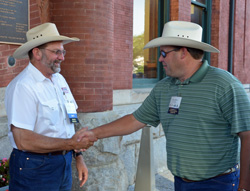
Jerry Etheridge with Montgomery Stockyards met guests at Union Station where the event was held and Chuck met up with him there. The team at the stockyards was proud to bring attendees a great southern meal along with some excellent southern music.
Jerry shared that the stockyards was started back in 1958 and continues to operate an established market with a great group of buyers each and every Monday.
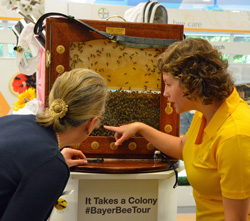
Time to add bee care to the endless list of projects Bayer has taken on. During Bayer’s 150th Anniversary attendees had the opportunity to take in the mobile bee exhibit that is touring the country through trade shows and meetings.
Robyn Kneed is the project lead for Bee Care at Bayer. She manages the bee camp programs throughout North America. Chuck attended the event and chatted with Robyn to get a little more insight into what Bayer is doing with bees.
She explained that the Bee Care Center has three purposes. The first is conducting research into honey bee health, alone and in conjunction with universities. Next, they plan to use the facility as a meeting place to bring together stakeholders to discuss research findings and information. Last, but certainly not least, the center will be used as a training and educational facility with info pieces explaining the importance of bees and what pollination services bring to agriculture.
The center is staffed with bee keepers who will manage the research bees and a communication and government affairs team helping to spread the word about bee health.
For more information on Bayer’s Bee Center or to stay up with all their research, check them out on Twitter, Facebook and YouTube.