
Discussing Eminent Domain
Tomorrow, I’m headed to the home of longtime friends Mike and Sue Sibson, cattle ranchers from western Miner County. They have asked me to come view their operation and help tell their story. The Sibsons were one of several South Dakota families to sign on to a lawsuit last year trying to prevent TransCanada from using eminent domain to seize easements from landowners along the proposed Keystone pipeline route.
A South Dakota political blog, Madville Times, did a feature on the Sibson’s struggles. Here is an excerpt…
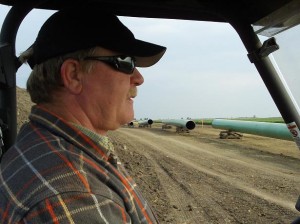
The Sibsons refer to their land, now sliced in half by the Keystone Pipeline, as their “homestead” of 30-some years. “Homestead” is a powerful word. It recalls where our people came from: traveling across wild land, picking one spot out of a million possibilities, staking survival—financial and physical—on their best guess that this patch of land might produce a good crop. Our ancestors came in response to a simple promise from the government: build a house, grow crops, tough it out, and the land is yours.
The Sibsons thought the land they worked for was theirs. They chose a spot twelve miles out of town, built a home, paid the bills with corn, wheat, and cattle. By sweat and wits, they earned their farm. They figured it was theirs, plain and simple…until last year, when a foreign corporation said, “No, actually, we can claim your land anytime we want,” and the government to which the Sibsons pay their taxes replied, “Yup, sure can.”
“I’m one of the only guys who can say he had a 2000-mile pipeline shoved up his ***,” says Mike Sibson.
This got me to thinking about the big subject of eminent domain and how it has an impact on land owners. From your experiences, what’s your take? What are your thoughts? Do you know someone who has been touched by eminent domain? I will report back with the full story later on. Thanks for your thoughts…


In this week's program Chuck talks with Mike Adams, AgriTalk.


1 Comment
MikeB
It may be significant that your search for eminent domain experiences is on the same web page as a discussion of social media. The two are certainly related nowadays.
My wife and I are among a group of property owners who have endured a transformative two-year eminent domain fight with Houston-based Spectra Energy, backed by the power of the Federal Energy Regulatory Commission.
This was a project located in Bedford County, PA (about 2 hours from Washington), that involved a 12 billion cubic feet underground natural gas storage facility — dubbed the Steckman Ridge Project.
Among many lessons, we learned that the energy industry has sweetheart lease deals with government entities that are very different from what it offers private property owners next door. (Just try to get copies of these lease agreements.)
To the energy companies, as one right-of-way agent admitted, state governments are big and scary — property owners are not. So it is good politics to give the government a better payment deal than property owners. As our attorney said, there is a lot of play in the “just” of “just compensation.”
For example, in lease agreements for underground gas storage fields, private property owners typically receive a one-time payment driven in part by the number of acres. But similar lease agreements with state governments (Pennsylvania, Ohio, New York, West Virginia) are significantly different
These leases include a 25-year annuity stream back to the state — in other words, a royalty for the amount of gas withdrawn and/or injected into the underground field.
So “just compensation” for the state is very different than “just compensation” for private property owners — even when the acreage is next door (e.g., state game lands).
As you might suspect, it is not a level playing field legally, economically or ethically for private property owners.
Property owners cannot depend on the kindness of strangers in government or at the energy companies.
Our fight led to the development of a website which focuses specifically on property rights that come under pressure from energy and utility companies. We are now helping and responding to inquiries from property owners in Pennsylvania, Texas, Oklahoma and elsewhere.
We have the distinction of being told by a Spectra Energy VP that he has never seen this level of property owner resistance in 26 years with the gas industry.
In addition to working with property owners in other counties in Pennsylvania and in other states, we are talking to legislators at the state and federal level; and I recently collaborated with an attorney in Pittsburgh (who counsels energy companies) to develop advice and expectations for property owners who are facing eminent domain and property rights issues. It is under “Recent Posts” on our website with the titles “Lawyers, Guns & Money — Parts 1 & 2.
Excellent organizations fighting eminent domain, like the Institute for Justice/Castle Coalition, do not deal with the “taking” power of government where public utilities and energy companies are concerned (because of the “public good” argument). We are trying to fill the gap.
Property owners can check out our website with landowner video and blog posts here:
http://www.spectraenergywatch.com/blog/
We get into issues like the 2004 Moss Bluff incident which was a catastrophic failure at Spectra Energy’s Texas storage field. The fire burned for 6 1/2 days and consumed 6 billion cubic feet of gas in an uncontrolled release. We researched and wrote it up because the company did not want to respond to questions — said our blog was not an appropriate forum.
In the meantime, we are looking for more examples of lease agreements utilities have with government entities that are better and richer than the agreements they provide to private property owners.
Good luck to your report on eminent domain and your website. As a wise farmer in our part of the country told a group of landowners: “The biggest fear of the natural gas companies is that you will educate yourselves and talk to your neighbors.”
All the best,
MikeB
Comments RSS feed —