The Prevention vs. Treatment Game

Jamie Johansen

bivi-15-ileitis-stpaul2-editedEvaluating the performance of a pig is a key element in good health management. Enteric Technical Manager for Boehringer Ingelheim Vetmedia, Inc. (BIVI), Jessica Seate, said the best thing a producer can do is become an investigator. Finding a diagnosis with your vet before you make changes to your protocol should be the first thing producers do. I sat down with Jessica at a recent BIVI event to learn more about antibiotic use in the swine industry and the role it plays in the prevention vs. treatment game.

“For BIVI and for the industry, we always want to do what is best for the pig. As an industry we are going the way of less antibiotic in production. Boehringer Ingelheim’s point of view is prevention works. Having a vaccination up front is a great way to help with a health management program and in turn use less antibiotics and control diseases ahead of time.”

Jessica said vaccinations should be one tool in a producers tool box. Other factors like management, biosecurity, sanitation and rodent control should also come into play. Vaccination programs will vary geographically, but most producers will be vaccinating for myco circo, ileitis, PRRS, salmonella, e-coli, etc. Jessica said you could talk to every vet and every schedule could be a little different.

Using ileitis as an example, Jessica said, “Vets will use the ileitis vaccination either by the label at three weeks of age and others are pushing it to five or six weeks of age. The exposure is usually in late nursery. Also you have to worry about the maternal antibody interference.”

Ease of application is always at the minds of producers. “Especially with enteric diseases, oral vaccinations are the way to go. You can easily put it in the water and we have a lot of methods and programs in place to make that even easier. It take times down. It takes labor down. And it is easier on the pig and easier on people.”

Listen to my complete interview Jessica here:Interview with Dr. Jessica Seate, Boehringer Ingelheim

View photos from the event here: 2015 BIVI Leman Media Event
Agribusiness, Animal Health, Audio, Boehringer Ingelheim, Swine

Canadian Farm Writers Get Together

Chuck Zimmerman

Canadian Farm Writers FederationMembers of the Canadian Farm Writers Federation will be getting together starting tomorrow in Calgary, Alberta, although there is a pre-tour today. Thanks to Case IH I will be able to attend this year!

We’ll have a welcome reception tomorrow night with farm tours on Friday and sessions and a banquet on Saturday. This year the conference is being hosted by the Alberta Farm Writers’ Association. The theme is “Fixing Fences: Bridging the Rural/Urban Divide.” As I find out what that means I’ll be sharing right here on AgWired.

The hashtag for the conference is #CFWF15 so follow along.

Uncategorized

Rocky Mountain Ag Tour 2015

Chuck Zimmerman

NAMA Fall ConferenceThe Rocky Mountain Chapter of the National Agri-Marketing Association conducted a tour just prior to this week’s NAMA Fall Conference. Titled, “Fun, Flour and Farm-to-Table,” this group visited Rock Creek Farm, Ardent Mills and Linger Restaurant. Photos from the tour can be found here.

After an opening reception last night the program kicks off with meetings and beginning workshops.

The hashtag for the conference is #NAMAFall15 so follow along if, like me, you can’t make the activities in Denver.

NAMA

New Holland Hero From Germany

Cindy Zimmerman

cnh-expo-elke-2The German representative in the New Holland “Seeds of Life Series” Heroes at Expo Milano is Elke Pelz-Thaller of Reichertshofen, Germany who works 44.5 hectares (110 acres) of barley, grain, rye, wheat, asparagus and potatoes together with her husband.

“Twenty years ago I married my husband and my profession was a nurse,” said Elke at the New Holland Heroes and Bloggers event last week in Milan. “I think I’m not a hero because my husband is the hero and I am the wife of the hero.”

Despite the Expo theme “Feeding the Planet, Energy for Life,” Elke laments the fact that most people know nothing about food production. “It would be very important for everyone who has a chance to visit this expo and think about feeding the planet,” she said. “German people have a lot of money for holidays, for everything – but food, it’s not important.”

Listen to my interview with Elke here: New Holland Hero Elke Pelz-Thaller from Germany

2015 New Holland Heroes & Bloggers Days

Audio, Farming, International, New Holland

Best College Farms In America Ranked

John Davis

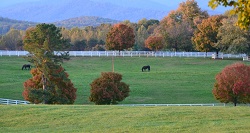
UVAfarm1The University of Virginia has the best college farm in the country. That’s according to College Ranker, as the website has ranked the top 40 college farms in America.

Hundreds of colleges are using their farms for educational experiences for their current students, creating community-based learning opportunities, providing food for use on campus and even local farmers markets.

The full ranking can be viewed here: http://www.collegeranker.com/ranking/best-college-farms/

These 40 college farms were selected after compiling scores and ranking college farms based on the following criteria:

* Hands-on experiences
* Student involvement
* Community outreach programs
* Workshops, classes, and lectures
* Volunteering opportunities
* Degree plan options

The University of Virginia tops the list, seemingly on the strength of its forest program:

Blandy Experimental Farm has a 172 acre Arboretum which is home to 5000 living trees. There are over 200 types of conifers, 162 kinds of boxwood, cedar of Lebanon alee, an herb garden and the Virginia Native Plant Trail. Public programs are offered to encourage life long learning. Programs include lectures, tours, children’s camps which teach about environmental issues, natural history, gardening and much more. Educational programs are available for K-12 students in the form of hands on exploration and research driven field investigations. Currently, the University is studying pollination, plant-animal interactions, defoliation cause by the destructive gypsy moth and what happens when plants are in-bred.

Highmoor Farm is a 278 acre agricultural and forest experiment station which provides research based information for the apple industry. The farm is also the site of vegetable and small fruit variety trails. Current trials include tomatoes, pumpkins, green peppers, onions, sweet corn and strawberries. Farm researchers are looking for a way to improve the transplant quality of muskmelons and to create new ways to manage corn ear worm on sweet corn as well as powdery mildew on pumpkins.

The next nine college farms are as follows:

2. University of Maine
3. Goshen College
4. Green Mountain College
5. University of Vermont
6. Warren Wilson College
7. Cornell University
8. Ferrum College
9. College of the Ozarks
10. Deep Springs College

Elizabeth Chapman, the article’s author, had this to say regarding the ranking: “We are excited to highlight these 40 farms. They are providing great resources to their students as well as the community. These schools are impacting the future of our country as they work to research and develop innovative ways to grow and provide for families around the globe.”

You can see the entire top 40 here.

Education, University

Soybean Association Wants SOY Scholarship Candidates

John Davis

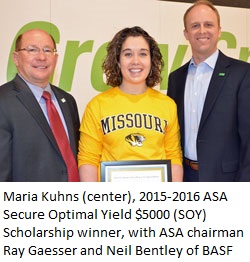
basf-soy-2015aThe American Soybean Association (ASA), once again, is looking to present a scholarship award to a high school senior interested in pursuing agriculture in college. ASA is offering its Secure Optimal Yield (SOY) Scholarship, a $5,000 one-time scholarship award presented to a high school senior who plans to pursue agriculture as an area of study at any accredited college or university in the 2016-17 academic year. BASF Corporation provides the grant for the scholarship, and interested applicants can apply now through Nov. 23, 2015 with the winner to be announced at Commodity Classic.

“ASA is happy to once again partner with BASF to offer this opportunity to an exceptional student pursuing a career in ag,” said ASA First Vice President Richard Wilkins, Greenwood, Del. “It’s imperative that we encourage today’s young people interested in agriculture and help them achieve their goals in any way we can.”

The scholarship is presented in $2,500 increments per semester. The student must be a child or grandchild of a current ASA member, maintain successful academic progress and be in good standing with the college or university to receive the full amount of the scholarship.

Final selection will be made the first week of December during the ASA Board meeting. The student will be notified prior to an official announcement made during Commodity Classic in New Orleans, La. on March 4, 2016.

“BASF considers the ASA to be our partners in preparing the next generation of agriculture professionals,” said Neil Bentley, director of marketing, US Crop, BASF. “This scholarship program is a way to reward students who excel in their studies, and it encourages them to learn more about careers in our industry.”

You can hear what last year’s winner, Maria Kuhns, had to say about being awarded the scholarship at Commodity Classic.

ASA, Soybean

New Holland Cocktail Contest

Chuck Zimmerman

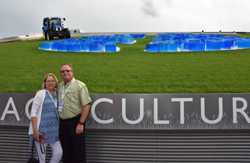
New Holland Expo Milano 2015As you know, Cindy and I spent some quality time with our good friends at New Holland, along with the farmers who are the heroes of the Seeds of Life campaign. We’re pictured in front of the New Holland pavilion at Expo Milano 2015.

It was a great opportunity to see the similar challenges farmers face around the world. Nearly all of them said that, just like here in the United States, they are unappreciated and even vilified by the non-farming public in their homelands.

The event included a chance to interact with the farmers and journalists from their respective countries, visit the expo, and enjoy some great Italian wining and dining. One of the more memorable events during the visit included a cocktail contest. We had four teams each create a cocktail in competition with judging. Each team had to create a name for their cocktail and describe it with a story in front of the judges. Below is me describing our team’s entry. If it doesn’t make much sense, don’t worry. It didn’t make a lot of sense to us either.


2015 New Holland Heroes & Bloggers Days Photo Album

New Holland, Video

Zimfo Bytes

Talia Goes

Zimfo Bytes

  • The Iowa Corn Cy-Hawk Series is a way to recognize the student athletes who give their all on the field and in the classroom.
  • When the record-breaking Commodity Classic convention and trade show wraps up next March in New Orleans, it’s going out in style – with an Evening of Entertainment, sponsored by Monsanto, spotlighting the multiple-award-winning country band Sawyer Brown.
  • Agricultural Research Service (ARS) scientist Douglas L. Karlen has been named the agency’s Distinguished Senior Research Scientist of the Year for 2015 for his work in developing solutions to soil and crop management problems.
  • The Council for Agricultural Science and Technology (CAST) invites you to attend a panel discussion cohosted by the Grocery Manufacturers Association on Oct. 5th.
Zimfo Bytes

Pig Performance in New Antibiotic World

Jamie Johansen

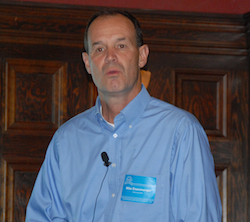
bivi-15-ileitis-stpaul14-editedBoehringer Ingelheim Vetmedica, Inc. hosted media in St. Paul, MN this weekend to talk about how proven prevention drives the use of less antibiotics. Dr. Mike Eisenmenger, Swine Vet Center, spoke on how to drive pig performance in today’s world of antibiotic usage.

“Instead of just saying our overall goal is to use less antibiotics at all costs, we are looking at different prevention strategies, i.e. vaccinations, to take the place of antibiotics like we have used in the past. It is just the right thing to do. The animal is always going to be happier with a prevention, never getting sick in the first place.”

He said the ways to accomplish using less and still having an ‘easy’ pig to raise stems around the elimination of diseases when possible, strong biosecurity programs and the development of a robust vaccination program.

Dr. Eisenmenger talked about what a typical vaccination program looks like at each stage of the growing cycle. He used ileitis as an example since it’s a disease that hits late in a pigs life. “Even if we institute a treatment program at that point in time, we are forced to use a lot of antibiotics. We want to back clear up to the nursery stage and apply an oral vaccine that will eliminate the problem that we would normally see without vaccinating.”

There seems to be a clear advantage to using oral vaccines and Dr. Eisenmenger said it’s simply ease of administration. “It is very easy to vaccinate a large number of pigs in short order and it provides almost no stress at all to the pigs themselves.” He added that if we could figure out how to put every vaccine in oral, it would be done. But science isn’t quite there yet.

“I think we as veterinarians need to protect antibiotics so we can continue to use it as a valuable asset in the future. My responsibility is to teach people that have been use to using a lot antibiotics the appropriate use of antibiotics, when to use them when you need them and when not to use them when another method of control could be done.”

Dr. Eisenmenger said his idea of a complete evaluation of pig performance is centered around pigs that grow fast to maximize production, but without forgetting about the environment, our duty to be stewards of the land and of course human health. “Buried within that is the use of antibiotics in a manner that protects them for the future and we will still be able to get good productions if we look at animal health from a prevention strategy rather than a treatment and control strategy.”

Listen to my complete interview with Dr. Eisenmenger here: Interview with Dr. Mike Eisenmenger, Swine Vet Center

View photos from the event here: 2015 BIVI Leman Media Event
Agribusiness, Animal Health, Audio, Boehringer Ingelheim, Swine

CSX, Bayer Provide National FFA Awards

Kelly Marshall

ffa_logo80 FFA chapters nationwide have created a plan for their communities in case of natural or environmental disaster.  These emergency preparedness plans will now receive funding, up to $2,000, to make them a reality.

The funds were provided by the National FFA Organization’s Living to Serve: Environmental or Natural Disaster/Emergency Preparedness Grant Program.  These grants are made are provided by CSX and Bayer as a special project of the National FFA Foundation.

“The grant program is a natural fit for CSX”, said John Kitchens, Corporate Citizenship Director. “Not only are we able to support these conscientious FFA students, but many of the environmental and disaster/emergency preparedness projects they contribute to in their communities align well with company priorities.”

Each winning project includes plans to invest the time of FFA members, community members and local leaders in a service-learning project that tackles issues of environmental, natural disaster or emergency preparedness nature. One awarded chapter from the LTS: Environmental Grant, Pierz FFA in Minnesota, is partnering with their local sanitation and solid waste management companies to reduce their carbon footprint. Their main focus will be to find ways to reuse or repurpose black silo bags, water bottles and tires. Some ways they will do this include: collecting used silo bags and cutting them into tarps that will be available to the public to be used as weed barriers in gardens, building greenhouses using used plastic water bottles and repurposing old tires from area farmers to be used as planters that will also be donated.

A recipient of the Natural Disaster and Emergency Preparedness Grant program is Greensburg FFA in Indiana. The chapter will be implementing a three pronged program titled, “Out of Harm’s Way.” It will focus on these areas: school building emergency preparedness, farm emergency plans and a safety program series. The safety program will be a series of short courses that will partner emergency response personnel with trained FFA members and interested students as presenters. Topics will include Water safety, ATV safety, Fire Safety, Firearm Safety, Severe Weather/Tornado Safety and Railway Safety. Each safety program will be targeted toward the specific demographic age group most prone to the accident type. 

Uniting FFA members with their communities illustrates the final line of the FFA motto, “Learning to Do, Doing to Learn, Earning to Live, Living to Serve.”  These projects provide a meaningful way to connect real-life with the leadership and educational skills learned in school.

Bayer, Environment, FFA