
Got Corn? Make Momomers Says DuPont at #CUTC16

Joanna Schroeder

Got corn? Then you can make some amazing things. For example, attendees at the Corn Utilization and Technology Conference (CUTC16) that took place in St. Louis this week learned about making new momomers for corn? Say what? Let’s get some insight from biomaterial expert Michael Saltzberg who is the business director for DuPont Industrial Biosciences’ biomaterials business.

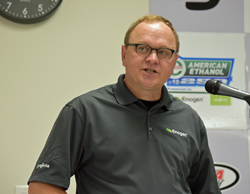
cutc-16-michael-saltzbergSaltzberg spoke on the Biorefining II panel where he discussed a new product they are developing in collaboration with ADM. They are working on a new momomer that uses fructose, from corn, as the raw material. It’s a process that uses chemical catalysis in a several step process that takes fructose to a momomer that’s called furan dicarboxylic acid methyl ester or FDME.

What’s exciting, said Saltzberg, is that this momomer can be used to make exiting new polymers especially in the packaging area. For example, helping soft drink and beer manufactures downgage their packaging but offer the same shelf life is important for them he said.

So what does this mean for the biorefinery industry? Saltzberg noted a major focus of the conference is to see what other applications can utilize some of the corn fractions. “This is a great way to take corn starch to fructose to a very valuable chemical out of it. So I think for the ag processing industry and for farmers it offers that kind of opportunity,” he said.

And for a company like DuPont, added Saltzberg, being able to develop new momomers through renewable raw materials and creating new polymers out of them enables them to assist their customers in solving some of their challenges.

To learn more about emerging momomers and their applications, listen to Chuck’s interview with Michael Saltzberg: Interview with Michael Saltzberg, DuPont

Check out pictures from the conference: 2016 CUTC Photo Album.

Audio, Corn, CUTC

New Oil Recovery Technology Featured at #CUTC16

Joanna Schroeder

Many ethanol plants across the U.S. are getting more out of each kernel of corn by producing corn oil as a by-product of ethanol production. However, there is a new oil recovery technology emerging that was discussed by Scott Kohl with White Energy during his presentation on the Biorefining I panel at the Corn Utilization and Technology Conference (CUTC). The event takes place every two years and focuses on emerging and new technologies using corn.

cutc-16-scott-kohlKohl said the dry grind ethanol industry represents about 80 percent of the U.S. capacity today and recovering oil from the process has become financially important for facilities. Approximately 80-85 percent of ethanol plants are recovering oil (corn oil) and this, Kohl noted, raises the plant’s bottom line.

However, one of the more important and interesting developments of late, Kohl said, is the technologies being crossed from traditional oil refining for human cooking oil to distillers oil and the quality of corn oil coming out of ethanol plants that adopt this technology will be substantially higher. Kohl said the oil looks similar to soybean oil in properties for biodiesel type applications, and he believes the raw value of the oil will be 8-10 cents a pound more. This is because the corn oil will be easier to refine into biodiesel than the current corn oil on the market.

Corn Oil One logoIn a nutshell, what’s happening, Kohl explained, is the dry grind industry is taking a process from one industry, wet milling, to another industry, dry milling, in an economical fashion. He said there is only one facility that he knows of today using this specific process and that’s Corn Oil One in Iowa – the first of its kind. The biorefinery has been running for a little more than a year and Kohl said the product is performing well. He added that he expects the model to be replicated over time as more data emerges from the early technology adopters.

On another note, Kohl said White Energy is doing extremely well and noted the company is most focused today on producing ever lower carbon renewable fuels.

To learn more about recovering oil and White Energy, listen to Chuck’s interview with Scott Kohl: Interview with Scott Kohl, White Energy

Check out pictures from the conference: 2016 CUTC Photo Album.

Audio, Biodiesel, Biofuels, Corn, CUTC, Ethanol

#Biofuel Supporters Rally for Higher Blends at Hearing

Cindy Zimmerman

#RFS Hearing Fuels American presserOver 120 biofuels advocates spoke out today at an Environmental Protection Agency (EPA) field hearing on proposed 2017 targets under the Renewable Fuel Standard (RFS) and several high profile supporters spoke at a Fuels America press conference.

Among the supporters was Nebraska governor Pete Ricketts. “A strong RFS means more jobs here at home, greater energy security, and a cleaner environment,” said Ricketts. “The biofuels industry supports more than 852,000 American jobs and creates fuel we need to help our country become energy independent.”

Missouri agriculture director and farmer Richard Fordyce was pleased to welcome the hearing to his state. “Missouri is the proud home of six majority farmer-owned ethanol plants, providing a vital market for our crops and affordable fuel options to our consumers,” said Fordyce. “As a fourth-generation farmer, I know how important these jobs are to our community.”

Among the farmer leaders who testified was Chip Bowling, president of the National Corn Growers Association. “Farmers, along with the ethanol industry and U.S. Department of Agriculture, have invested millions in new ethanol pumps and fuel infrastructure so that drivers can access affordable, renewable fuel choices,” said Bowling. “Now it’s up to the EPA to deliver on its promises. We have the resources to meet all our needs, spur investment in rural communities, and create more high-tech jobs.”

The hearing even featured Iowa celebrity farmer Chris Soules, star of The Bachelor. “The ethanol market provides financial stability to our family farm and guarantees that we can pass on our traditions to future generations,” Souls said during the press conference. “American consumers are winners from this policy, too. Protecting choice at the pump means offering consumers a clean, homegrown, and less expensive product.”

Others who spoke at the RFS press conference included Renewable Fuels Association president and CEO Bob Dinneen, Growth Energy CEO Emily Skor, Iowa farmer and former state representative Annette Sweeney, and Brian Sowers, Missouri sportsman and Co-Host of Crappie Masters TV.

Listen to the full press conference here: Fuels America RFS Hearing Press Conference

Check out the EPA Hearing Photo Album.

Audio, Biodiesel, Biofuels, Corn, EPA, Ethanol, NCGA, RFA

RFA Urges EPA to Get #RFS Back on Track

Cindy Zimmerman

Bob DinneenOver 100 biofuels supporters were in Kansas City today for a public hearing on the EPA’s proposed volume obligations under the Renewable Fuel Standard (RFS). Chuck has been on the ground there all day along with farmers and representatives from agricultural and biofuels organizations.

Up on the first panel was Renewable Fuels Association (RFA) president and CEO Bob Dinneen who had strong words for the EPA.

“We encourage EPA to truly put the RFS ‘back on track’ and finalize the 2017 conventional renewable fuel renewable volume obligation (RVO) at the 15-billion-gallon statutory level. EPA’s proposed rule for the 2017 RVOs marks an improvement over the final rule for 2014-2016 RVOs, but it ultimately falls victim to the same legal malady that plagued your last rulemaking,” Dinneen testified. “Simply put, EPA continues to allege that ‘supply’ somehow equates to the capacity to distribute or consume renewable fuels. However, the statute does not allow EPA to consider imagined constraints on distribution when deciding whether to utilize a general waiver of the volumes. The intent of Congress was abundantly clear: if the physical supply of renewable fuel exists to satisfy statutory volumes, then EPA must enforce the consumption of those volumes. And it is beyond dispute that the industry is providing an adequate supply to meet the statutory mandate for conventional biofuels.”

Listen to Dinneen’s full testimony statement here: RFA CEO Bob Dinneen EPA hearing testimony

Check out the EPA Hearing Photo Album.

Coverage of EPA RFS Hearing made possible by Coverage of EPA RFS Hearing made possible by Renewable Fuels Association
Audio, EPA, Ethanol, RFA

#CUTC16 Addresses the Value in Big Data

Kelly Marshall

cutc-16-jeremy-wilsonJeremy Wilson works for Crop IMS and knows a thing or two about big data.  In his presentation, Data Share and Share Alike at the Corn Utilization and Technology Conference, Wilson addresses the information recorded on a farm and who should be given access to it.

On his own farm Wilson says they share all their information with someone, because there is a third party who can offer value for every bit of data collected.  But that doesn’t mean he’ll hand over valuable numbers to just anyone.  The key is finding the company or service that will interpret that data in a way that enhances the overall operation.  Data should equal value, in other words.

And because data is valuable its important that data collection is of good quality. Every person who operates a monitor should understand how it works.  Most systems will allow a driver to punch a couple of buttons, engage the GPS and take off, but that doesn’t mean the information collected is sound.  This diminishes the the quality of information a third party can give back to a grower.

“Yield data, applications data, planting data; you only get one chance each growing season to get good, quality data. And if we loose it, its gone. We never get to get it back,” Wilson emphasizes.

Hopefully in the future user interfaces will become more friendly.  Organizations on the machine and data side of the issue are working to create data standards, making it easier for an operator to know if all is well on a monitor.  Great strides have been taken in the last 3-5 years– the next few years should make data collection a simpler task, Wilson encourages.

You can hear Chuck’s full interview here: Interview with Jeremy Wilson

Check out pictures from the conference: 2016 CUTC Photo Album.

Agribusiness, CUTC, data

New Pork Board CEO Bill Even at #WPX16

Cindy Zimmerman

wpx-16-54-editedEarlier this month the National Pork Board named Bill Even as their new CEO. No stranger to the agricultural community or swine industry, Bill sat down with me at the 2016 World Pork Expo to discuss their key components focusing on people, pigs and the planet.

The people component is centered around connecting with consumers while building trust. The pig highlights how producers care for their animals and the importance of relaying that to the consumer. And finally, the planet ensures we have the best sustainable practices in place and always striving for continuous improvement.

“When I think about implementing our strategic plan and look at my first 90 days on the job, there are a lot of people in the industry that I need to meet and connect with. The World Pork Expo has given me fantastic opportunities to meet all the key players in the industry throughout the U.S. and globally.”

Listen to my complete interview with Bill here: Interview with National Pork Board CEO, Bill Even

View and download photos from the event here:2016 World Pork Expo Photo Album

wpx-bivi-tag

Audio, Pork, World Pork Expo

Flinn Joins Brownfield Ag News

Kelly Marshall

FlinnPicAndrew Flinn is joining Brownfield Ag News as an anchor/reporter in his home state of Ohio. For the past 15 years Flinn has been reporting new and agriculture, 14 of those with Brownfield affiliate WKTN.

“Andrew’s years of experience covering news and agriculture for local radio stations in Ohio makes him a great addition to the Brownfield team,” says Cyndi Young-Puyear, Director of Brownfield & Ag Operations.

Flinn holds a degree from the University of Findlay in communications and public relations, as well as an associate degree in broadcast production and engineering.  He has a been involved in agriculture in a variety of ways, serving as a member of the Hardin Country 4-H Advisory Board, Hardin Coutry  Agriculture Hall of Fame Committee and the Hardin County Ag Council. He has also been involved in the Hardin County Chamber of Commerce & Business Alliance and the Kenton Kiwanis Club.

Agribusiness

The Buzz About Sustainability at #CUTC16

Kelly Marshall

cutc-16-fred-yoderFred Yoder is an Ohio corn farmer who believes sustainability is more than a buzz word. At the Corn Utilization and Technology Conference Yoder told AgWired about his involvement with Climate Smart Agriculture, a term coined to describe just what it is growers will have to do to feed 9 billion people while working with what we’ve got. Working with the climate, Yoder explains, means adapting to changes, taking the bad weather with the good and figuring out how to use that to make farmers more productive.

More productive, it turns out, is often the same as more economical. Climate Smart Agriculture is founded on three main pillars; more productivity, adaptation and resilience, and reducing greenhouse gas emissions. When Yoder began his own journey in sustainability he said it started with conservation tillage and cover crops to become more productive. By adapting his practices with grid sampling and variable rates he began to see that the economics were leading to a reduction in greenhouse gas emissions on his farm.

It takes leaders, Yoder states, to make farming more sustainable. Someone needs to be out there being innovative on their ground. You don’t always make money at first, but then, very often, you do. And every farmer should be trying something, he believes.

“We need leaders to get out there and try it.  Every farmer ought to be trying something on the back forty that he is not necessarily comfortable with, but just try it.  Most of the time it works better than he thinks.”

You can listen to Chuck’s full interview here: Interview with Fred Yoder

Check out pictures from the conference: 2016 CUTC Photo Album;

Agribusiness, Conservation, CUTC, Sustainability

I AM @USFRA – Carla Wardin

Cindy Zimmerman

i-am-usfra-webCarla Wardin is a busy mother of three boys and a 6th generation dairy farmer with her husband in Michigan. She’s also one of the Faces of Farming and Ranching for the U.S. Farmers and Ranchers Alliance (USFRA).

“I really enjoy speaking with consumers and other people in agriculture about the issues in farming today,” Carla says. “The part I like best is the people.”

usfra-carlaCarla blogs about her life on the farm, and enjoys going into schools to teach about farming and giving tours. “Because I’m so easily reachable, people will text me or email me or send me questions,” she says. “Anything they have questions about, they know they have a farmer they can reach.”

Carla is one of the second class of USFRA Faces and right now a search is on for the next crop of “spokesfarmers” to represent the industry. “It really does allow you to reach more people,” said Carla. “Through USFRA, they are literally giving a face to farmers and through that I feel that I am able to reach people who want to talk to a real farmer.”

Because the Faces program is so diverse and includes farmers and ranchers of all kinds of commodities and various areas of the country, Carla says it provides a broad view of the agriculture industry. “Because you are often the only farmer that someone knows, they’ll ask you about everything,” she said. “You can always say I know the person I can give you to who knows the information you’re looking for.”

Interested farmers and ranchers can apply for the program online by July 10, 2016 and will need to include a home video of less than three minutes describing themselves and their farm or ranch. Among other criteria, farmers and ranchers must have an existing social media presence, either through Facebook, Twitter, Instagram and/or a blog. A combination of public voting and USFRA judging scores will be used to determine the winners, who will be announced on November 9 at the National Association of Farm Broadcasting Convention (NAFB) in Kansas City.

Learn more about Carla and being a USFRA Faces of Farming and Ranching here: Interview with Carla Wardin, USFRA Faces of Farming

usfra-banner

Audio, USFRA

#CUTC16 Addresses Future of Wet Milling Technologies

Kelly Marshall

cutc-16-panelThe Corn Utilization Technology Conference is covering a wide variety of topics, including new technologies from the wet milling process of corn.  Members of a panel discussion met with Chuck to let him in on just what they were hoping listeners gained from their presentation.

Brent Shanks, a Ph.D. with Iowa State University covered the conversion of biomes and bio-based carbon into chemicals and materials and the paradigm of how to go after those products.

Kevin Coffman, part of the market development in ag environmental strategy group at Monsanto addressed corn in the pipeline be it traded material for an ethanol plant or any other food grade type of opportunity for the market for corn producers.  Most importantly, Coffman said, was the idea that a low carbon  agriculture product like ethanol might be the fuel of the future.

John White, Ph.D. at White Technical Research works as a consultant to the food and beverage industry in the area of sweeteners.  The milling process of corn can produce a wide range of sweeteners, he explained, including new ones being designed for today’s demands.

Raghunath V. Chaudhari, Ph.D. works at the University of Kansas in the area of converting biomes to chemical with the use of a catalyst.  New catalytic materials can change our use of current technologies to create something better, he tells AgWired.

Overall, Tom Binder, self proclaimed “referee” for the event hopes viewers went home with a better idea of future new uses for corn, in wet milling and otherwise.

Listen to Chuck’s full interview with the panel here: Interview with CUTC Wet Milling Technologies Panel

Check out pictures from the conference: 2016 CUTC Photo Album;

Agribusiness, Biofuels, Corn, CUTC