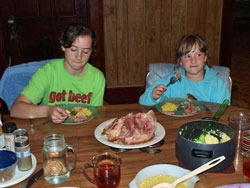
Nothing fuels an Earth Day dinner better than beef.
I think that’s what Beef Ambassador Allison Grainger and friends are telling us in this Earth Day Beef Rap video.
Let me know what you think. I’m sure Allison will be watching.
Nothing fuels an Earth Day dinner better than beef.
I think that’s what Beef Ambassador Allison Grainger and friends are telling us in this Earth Day Beef Rap video.
Let me know what you think. I’m sure Allison will be watching.
Rabobank has released results of its 2009 Farm & Ranch Survey. A couple of highlight include:
* More farmers are using risk management tools
* 1/3 of farmers expect crop input costs to decrease
* More farmers looking to buy used equipment
Rabobank recently launched a survey to gauge farmers’ confidence, and found that, while farmers’ outlook on the economy generally mirrors that of the overall population, more than half of farmers surveyed are employing risk management strategies to help navigate this difficult economic climate.
“Our survey demonstrates that U.S. farmers and ranchers are tackling the current economic environment head on by making smart choices to help them weather the storm,” said John Ryan, president and CEO for Rabo AgriFinance. “While many are hurting because of the economy, there is some optimism that the situation will improve next year.”
According to the Rabobank Farm & Ranch Survey, more than half of U.S. farmers have recently implemented or plan on investing in risk management or marketing strategies. Among those, pre-selling crops/livestock is the most regularly used risk management approach, followed by hedging future commodity sales and lock-in margins.
Just in case you’re wondering if your company should be involved in social media, let me give you another example. This comes from Iowa Farm Bureau. It’s all about a farmer who’s on Twitter to help promote agriculture. I’m really glad to see how Farm Bureau is getting into the online conversation. In fact, I’ll be speaking to their gathering of state public relations directors in June. Not only is AFBF involved but a number of state groups like Iowa!
Mike Ver Steeg is not only a farmer. He’s also known as a food provider. And it’s @foodprovider, to be exact.
The title is his handle on the online site called Twitter. At www.twitter.com, users send short messages that are read by their followers. Some folks use it to keep in touch with friends, while others use it to communicate with colleagues.
Ver Steeg uses it to promote agriculture. After signing onto the site at the end of February, he already has 108 followers that include a global farming organization based in France, a California dairyman, a cattleman in South Dakota and a rural vet in southeast Iowa.
“I’d just heard about it and thought I’d try it out,” explained Ver Steeg who farms near Inwood. “My wife, Sarah, and I had just ended our term on the American Farm Bureau Young Farmer Committee. That group’s goal was to get ag’s message out.”
Ver Steeg had been doing just that, visiting local Rotary groups and business clubs. But using Twitter has opened up a global opportunity. All he needs is a few free minutes and his laptop.
So, if your farmer customers are there then why aren’t you? I see very few ag companies involved in the online conversation yet. Some have jumped in with both feet, many haven’t even taken their shoes off yet. What’s holding you back? Need some help? Let me know and I’ll do my best to ‘splain things.
Gary Truitt, Hoosier Ag Today, has unveiled a new ZimmComm-designed website called Indiana Family Farms.
Consumers today are interested in knowing more about how their food is produced. Environmental, safety, and welfare issues are figuring more and more in consumer buying decisions. Yet, most Americans know very little about how their food is produced or the men and women who produce it. A newly-launched web site is designed to give people a firsthand look at livestock production in Indiana and the people behind it. Indiana Family Farms (www.indianafamilyfarms.org) profiles Indiana beef, pork, and dairy farmers and lets them, in their own words, tell their stories. With photos, text, and audio, these producers tell the history of their farms, share their approach to meat production, and express their values. Visitors to the site will get a sense of what life is like on a livestock farm as well get an idea of the kind of people that make up the Indiana livestock industry. Visitors can also e-mail any questions to the farm families as well as click on a variety of educational resources on this site to learn more.
Currently there are 6 farms featured on the site, but this will grow as more producers are added. The site was developed and is administered by The Hoosier Ag Today Foundation with funding from the Indiana State Department of Agriculture.
As I prepare to graduate in May and begin my career as a freelance writer, I want to be sure I get started in this field on the right foot. What tools are journalists using, and how do they communicate with each other? Are you on LinkedIn? I have been invited by several people already, but I haven’t taken the plunge. I figure it’s just ONE more profile I would need to keep up, and my Facebook profile is already an outlet for people to find me online.
If you aren’t familiar with LinkedIn. This is a social networking tool aimed for professionals. Currently, over 35 million professionals login to share ideas, connect with colleagues and share their working profiles. The site boasts that with LinkedIn you can, stay informed about your contacts and industry, find the people and knowledge you need to achieve your goals and control your professional identity online.
If you are on LinkedIn, what do you like about it? If you aren’t, why have you never joined? What do you think about networking with professionals online? Is this the best way to share your resume or communicate with colleagues? Don’t be counted out; weigh in with your thoughts and ideas! Thanks for your input!
I took a 24 hour trip to Kansas City to give a speech to the North American Limousin Junior Association (NALJA) Board of Directors. I spoke on utilizing online media resources to tell the agriculture story. Before my speech, we all took part in a leadership workshop. NALJA Director Cassiday Woodard explained the importance of leadership in agriculture, and she helped us to identify our strengths and weaknesses in that area.
We started the workshop by taking a short quiz that sorted and rated the responses into five categories. The quiz came from a book by Kouzes and Posner. After taking the quiz and tallying up our scores, she explained the five leadership traits and how we can improve on our weak traits in the future.
The five leadership traits include:
1) Model the way. Be the leader that you would want to follow.
2) Inspire a shared vision. Work in a group towards a common goal.
3) Challenge the process. Take risks and try something that has never been done before.
4) Enable others to act. Inspire those around you to follow your lead.
5) Encourage the heart. Help others help themselves. Be kind and show others you care.
This was a refreshing course that reminded me how important strong leaders are in agriculture. I don’t want to be lost in a flock of sheep; I want to be the lead horse guiding the cowherd. Does that metaphor make sense? Ha! Anyway, Cassidy left us with some great leadership quotes that really drove the point home. Here are a few of my favorites…
Every leader needs to look back once in awhile to make sure he has followers. -Kouzes and Posner
If your actions inspire others to dream more, learn more, do more and become more, you are a leader. -John Quincy Adams
Celebrate what you’ve accomplished, but raise the bar a little higher each time you succeed. -Mia Hamm
I ran across this article, Planting Cyber Seeds, written by Jeffrey Tomich for the St. Louis Post-Dispatch, and I thought I would share it will all of you. The article is about how Monsanto has worked to tackle big issues through Twitter, the social networking tool that answers the question, What are you doing?
Because environmentalists were constantly trying to derail Monsanto in the media, the company quickly realized that they needed to address some big issues in the news for themselves. The group uses Twitter to discuss controversial topics like food labeling and genetically modified foods. Like many agriculture groups, Monsanto has realized that this is the best outlet to interacting with the nation’s food consumers. I know a lot of people utilize Twitter to share basic information, (i.e. location, dinner plans, random thoughts…) but I’m quickly discovering it’s a great tool to share press releases, studies, great websites and even photos. Do you use Twitter, and how do you utilize it in your professional career? “Planting cyber seeds” proves that Twitter is a social networking tool worth considering…
Monsanto’s presence on the Web has evolved during the last few years. But only last year did the company decide to delve into social media as it witnessed the upheaval of traditional media and realized that its existing outreach vehicle — news releases — wasn’t enough.
“We asked ourselves, ‘Is this a space we should be participating in?’ The answer was ‘yes.'”
While some consumer companies have used blogs and Twitter to promote their products, Monsanto views social media as a forum to discuss key issues with critics, investors and customers. The company and its critics agreed on one thing: Food is an emotional issue. Knowing that, Monsanto hopes using social media will help put a human face on the company and connect with people who might perceive it as a monolith trying to dominate global agriculture.
Virgil Smail has been named the Executive Director of the United Sorghum Checkoff Program.
With a strong history of industry and commodity association management, Smail will bring great experience and leadership to the USCP. As President and CEO of the American Institute of Baking, Smail was responsible for drastically expanding institute programs and worked with a Board of Directors representing the top 30 baking and allied industry presidents and senior vice presidents. In his most recent career accomplishment, Smail served as Senior Director of Research and Development for the Milling Division of ConAgra Foods.
“The USCP Board and I look forward to working with Virgil and are extremely confident in his leadership ability,” Bill Greving, USCP Board Chair, said. “He brings a successful track record from his past employment and brings a level of expertise that we believe will be beneficial in furthering Checkoff Program initiatives to improve profitability for sorghum producers.”
Smail served as the first full-time Director and CEO of the National Association of Wheat Growers Foundation in Washington, D.C. and collaborated closely with growers and industry representatives while implementing Foundation activities. He also worked with sorghum breeding programs as the Vice-President of Corporate Development for Biotechnica Agriculture and on the Egyptian Major Cereals Improvement Program in Egypt, a USAID funded project.
The organization has positions open for: Communications Director, Marketing Director and Field Services Director (pdf)
Another ag group shows a great use of a blog. This time it’s Karen Simon, Iowa Soybean Association. She just returned from a 10 day trip to China. I actually was following her progress on her Twitter feed but she kept an online journal. This is one of her photos I borrowed from her online photo set.
She also posted audio interviews and video clips like this one:
I spoke to Karen this morning and she reminded me that China blocks YouTube so she had to use her Flickr account to post the video. Flickr only lets you load a 90 second clip though which they interestingly call a “long photo.”