
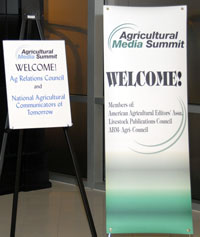
So Long From AMS
It’s time to hit the road again. Another Ag Media Summit has come and gone. I want to take this chance to thank some folks.
Thank you first of all to Dave Krog and Ken Benkstein and Agragate Climate Credits Corporation for sponsoring my coverage of the AMS this year. Thanks to everyone who attended my workshops and said such kind words afterwards. Thanks to the committee and staff who put this program together and made attending and working here so enjoyable. Thanks to BASF for sponsoring the media room. It’s so nice to have a place to work that’s conveniently located and has good high speed internet access. Thanks to all of you who read and subscribe to AgWired. I can’t tell you how much the words of encouragement I’ve heard here mean to me.
So, it’s onward to the next stop on the agricultural marketing and communications highway.
Don’t forget to check out the photo album and feel free to download them if you need them. I think there’s over 250 in there.
AgWired coverage of the Ag Media Summit
is being sponsored by: 



Marketing to the country lifestyle people is the topic once again of this week's program.


3 Comments
Andrew
Hi Chuck,
I posted a comment on your blog after reading your post about the factory farm map. I’m assuming that you simply never saw it. I really hope that you will get back to me so that we can open a dialogue. Here’s the comment:
“Let me say right away that I actually work for an organization like the ones you mention in this post.
I’m not writing here to argue with you. I agree that an “us vs. them” mentality can be counter-productive, particularly when you and I are just two people sitting at computers. We can accomplish much more by communicating effectively with each other - trying to understand the issues from the other person’s point of view.
Believe it or not, I do what I do not for my own personal gain, but because I think it will benefit the American people. A lot of those I work alongside care deeply about the animals, but I care much more about the people. I take issue with enormous livestock operations because of the damage they cause to people’s drinking water, breathing air, and property values.
This is where the communication gap between you and me becomes so important. You probably won’t be surprised to learn that I don’t have a firm understanding of the economic realities of running a farm. I haven’t even seen a livestock facility with my own eyes.
If you, as someone with much more experience in these matters, think I’m horribly misguided, I truly would like to know. I don’t want to waste my life. I agree with you that one of the major problems facing organizations like mine is that we’re often based in big cities. At the same time as we work to help rural America, we are (many of us, anyway) pretty out of touch with rural America.
Please write back to me, either by e-mail or as a comment following mine, and tell me why you think that people like me are bad for farmers. I’d hate to spend any more time doing what I’m doing, thinking that I’m helping farmers, when really I’m doing the opposite.
Breaking the barrier between me and you is a critical first step toward breaking the barrier between “us” and “them.” An open, honest dialogue can only help.
Best,
-Andrew”
Chuck
I did see your comment, which I approved in order for it to show up. First of all, I haven’t had time to respond due to travel and work.
I just find it amazing how judgmental you can be without “having seen a livestock facility.” You’re apparently working for a cause without even knowing the facts or what you’re talking about.
If you want to break down a barrier then get yourself out on a farm. Yes even a big one. You might be amazed what you’ll find.
Me, I don’t just “sit at a computer” although I’m often at one. I travel with mine and that includes out to the farm where you’ll find high speed internet access these days.
The danger with the type of organization it sounds like you work for (since you didn’t bother to mention which one) is that you gain the ear of media whackos who don’t check their facts either and then all you’re doing is spreading a myth which impacts legislation and the ability of hard working Americans to make a living and in the case of farmers, feed you.
Andrew
Hey Chuck,
Thanks so much for getting back to me. I really appreciate your comments. We can keep going back and forth like this below your post, but it might be easier for you to e-mail me (andrewbarnet@gmail.com).
I think you’re right about the need for me to see for myself a large animal facility. I plan on doing that soon, although I’ve heard and read that it might be hard to get myself in (although obviously I shouldn’t believe everything I hear and read).
Even without that experience, I find it hard to believe that the pollution from large-scale feedlots is a myth. There is certainly a lot of biased information out there, but there are also objective third-party sources, like the Department of Justice. Here are a couple of links detailing the cases against two such facilities:
http://www.usdoj.gov/opa/pr/2006/July/06_enrd_433.html
http://www.usdoj.gov/opa/pr/2003/November/03_enrd_634.htm
You and I almost certainly disagree about how common places like these are. We can save that debate for another time. Right now, I’m interested in what you think about those specific cases. Do you think that a dairy ought to be able to release a million pounds of manure into a waterway? Do you think that the DOJ got the facts wrong?
I don’t at all agree with government micro-management of anyone, especially farmers. I think people ought to be able to do with themselves and their property pretty much whatever they like. However, I think that the government should protect people from harm by other people. If someone else is polluting the air I breathe, shouldn’t I have legal recourse to make that person stop?
I realize that you’re very busy with other commitments, but I’d like it if you could get back to me with whatever thoughts you have.
Best,
-Andrew
Comments RSS feed —